
Business Education Research and Scholarship Network
A research network committed to developing innovation and establishing best practice in Business School education, across all its disciplines.
Business Education Research and Scholarship Network (BERS) welcomes both active and aspiring pedagogic researchers and those interested in scholarship of teaching and learning. We provide a facilitation network to connect those with similar interests across business school disciplines and support for development at all stages of the research and scholarship process: from inception to delivery.
Whilst we welcome any pedagogic or scholarship of teaching and learning activity, we have two primary themes:
1. Artificial Intelligence for Business Education
We are all, as educators, feeling the impact of AI on our practice. At the moment the focus is on detection and prevention of unauthorized use in assessments by students. However, the agenda is rapidly moving on to embracing AI within teaching, learning and assessment and reflecting on how we need to change content, structure and delivery of education to achieve an offering that extracts maximum value for all Business School disciplines from the developing technological environment.
2. Developing Excellence in New Forms of Education Delivery
The Business School’s strategy involves developing new forms of education. The form of educational offering is also evolving because of technology or university or sector aspirations for teaching and learning. This includes:
- Interdisciplinary teaching
- Executive Education
- Short courses and masterclasses
- Widening participation support
- Group dissertations
- Online programmes
- Effective integration of online education within on-campus programmes
- Co-creation with employers and other external stakeholders
- Integrating mentoring and work-based placements within the curricula
- New forms of authentic assessment.
Current members (Updated April 2025)
- Mr Akinyo Ola
- Professor Andrew Sturdy
- Mrs Angela Parry-Lowther
- Dr Aniekan Essien
- Mrs Anna Macpherson
- Dr Annika Skoglund
- Dr Antony Beckett
- Professor Brian Squire
- Mrs Charlotte Belling
- Dr Chiara Bottausci
- Dr Claire O’Neill
- Ms Claire Spencer
- Dr Emma Carrol
- Dr Enoch Quaye
- Dr Fatima Lopez Castellanos
- Dr Giuseppe Pratobevera
- Dr Graham Abbey
- Professor Hinrich Voss
- Mr Jon Wellington
- Dr Karina Pavlisa
- Dr Kellys Sikabbwele
- Dr Lei Wang
- Dr Marios Kremantzis
- Mr Martin Diedrich
- Dr Ming Luo
- Dr Minhao Zhang
- Dr Neil Lambert
- Mr Nick Kent
- Dr Oghale Ayetuoma
- Professor Paula Hill
- Dr Rachael Lamb
- Dr Ronald Lui
- Mrs Sam Bell
- Dr Sophie Lythreatis
- Dr Sotiris Lalaounis
- Dr Surya Mahdi
- Dr Tao Wang
- Miss Tauheed Ali
- Dr Xiaolong Shui
- Dr Xiaoting Luo
- Dr Yingtong Dai
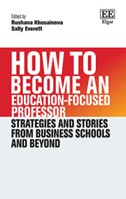
How to Become an Education-Focused Professor: Strategies and Stories from Business Schools and Beyond, edited by Rushana Khusainova (University of Bristol) and Sally Everett (King’s College London) and published by Edward Elgar, explores how academics can build successful careers centred on teaching and educational leadership. Drawing on real experiences across disciplines and career stages, the book also addresses contemporary issues shaping higher education, including generative AI, changing student expectations and the evolving role of education-focused academic careers.
Join us at the University of Bristol Business School for the official launch of How to Become an Education-Focused Professor: Strategies and Stories from Business Schools and Beyond featuring a panel discussion with chapter contributors, followed by networking with colleagues from across the higher education sector. Whether you're an early-career academic, experienced educator or academic leader, we invite you to join the conversation.
Chapters by BERS members:
- Marios Dominikos Kremantzis (with Xue Zhou) – Strategic use of GenAI in education-focused academic careers
- Lloyd Fletcher – From boardroom to classroom: Leveraging your business background
- Wayne Holland – Making the most of leadership roles
- Rushana Khusainova – Visibility and personal brand for career development
- Rachael Lamb – Creating connections, shaping futures: Building professional networks as an education-focused academic
The book is accompanied by The Education-Focused Academic Podcast, hosted by Rushana Khusainova and Sally Everett, which shares stories, strategies and practical insights from contributors and other scholars to support academics pursuing education-focused careers.